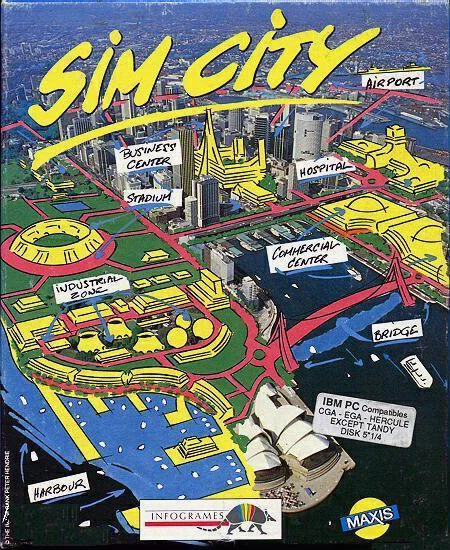

SimCity
SimCity is a city-building simulation game, first released in 1989 and designed by Will Wright. SimCity was Maxis first product, which has since been ported into various personal computers and Video game consoles, and enhanced into several different versions including SimCity 2000 in 1993, SimCity 3000 in 1999, SimCity 4 in 2003, and SimCity DS, SimCity Societies in 2007, and SimCity (2013). The original SimCity was later renamed SimCity Classic. Until the release of The Sims in 2000, the SimCity series was the best-selling line of computer games made by Maxis.
SimCity spawned an entire series of Since the release of SimCity, similar simulation games have been released focusing on different aspects of reality such as business simulation in
On January 10 2008 the SimCity source code was released under the free software license under the name Micropolis.
History
SimCity was originally developed by game designer Will Wright. The inspiration for SimCity came from a feature of the game that allowed Wright to create his own maps during development. Wright soon found he enjoyed creating maps more than playing the actual game, and SimCity was born.
In addition, Wright also was inspired by reading "The Seventh Sally", a short story by in which an engineer encounters a deposed tyrant, and creates a miniature city with artificial citizens for the tyrant to oppress.
The first version of the game was developed for the Commodore 64 in 1985, but it would not be published for another four years.
The game represented an unusual paradigm in computer gaming, in that it could neither be won nor lost; as a result, game publishers did not believe it was possible to market and sell such a game successfully. declined to publish the title when Wright proposed it, and he pitched it to a range of major game publishers without success. Finally, founder Jeff Braun of then-tiny Maxis agreed to publish SimCity as one of two initial games for the company.
Wright and Braun returned to Brøderbund to formally clear the rights to the game in 1988, when SimCity was near completion. Brøderbund executives Gary Carlston and saw that the title was infectious and fun, and signed Maxis to a distribution deal for both of its initial games. With that, four years after initial development, SimCity was released for the Amiga and Macintosh platforms, followed by the IBM PC and Commodore 64 later in 1989.
On January 10 2008 the SimCity source code was released under the free software license. The release of the source code was related to the donation of SimCity software to the laptop, as one of the principles of the OLPC laptop is the use of free and open source software. The open source version will be called Micropolis since EA retains the rights to the name 'SimCity'. The version shipped on OLPC laptops will still be called SimCity, but will have to be tested by EA quality assurance before each release to be able to use that name.
Objective
The objective of SimCity, as the name of the game suggests, is to build and design a city, without specific goals to achieve. The player can mark land as being zoned as commercial, industrial, or residential, add buildings, change the tax rate, build a power grid, build transportation systems and many other actions, in order to enhance the city.
Also, the player may face disasters including: flooding, tornadoes, fires often from air disasters or even The Sims 2 Castaway shipwrecks, earthquakes and attacks by monsters. In addition, monsters and tornadoes can trigger train crashes by running into passing trains. Later disasters in the game's sequels included lightning strikes, volcanoes, meteors and attack by aliens.
In the SNES version and later, one can also build rewards when they are given to them, such as a mayor's mansion, casino, etc.
Scenarios
The original SimCity kicked off a tradition of goal-centered, timed scenarios that could be won or lost depending on the performance of the player. The original cities were all based on real world cities and attempted to re-create their general layout, a tradition carried on in SimCity 2000 and in special scenario packs. While most scenarios either take place in a fictional timeline or have a city under siege by a fictional disaster, a handful of available scenarios are based on actual historical events.
The original scenarios are:
- Bern 1965 - The Swiss capital is clogged with traffic, the mayor needs to reduce traffic and improve the city.
- Boston, Massachusetts, 2010 - The city's nuclear power plant suffers a meltdown, irradiating a portion of the city. The mayor must rebuild, contain the toxic areas, and return the city to prosperity. In some early editions of SimCity on lower-power computers that did not include the nuclear power plants, this scenario was altered to have a tornado strike the city. Much like the Tokyo scenario below, the mayor needs to limit damage and rebuild.
- Detroit, Michigan, 1972 - Burglars Crime and depressed industry wreck the city. The mayor needs to reduce crime and reorganize the city to better develop. The scenario is a reference to Detroit's declining state during the late 20th century.
- Rio de Janeiro, 2047 - Coastal flooding resulted from global warming rages through the city. The mayor must control the problem and rebuild. In some early editions of SimCity on lower-power computers that did not include the flooding disaster this scenario was altered to have the objective be fighting high crime.
- San Francisco, California, 1906 - An earthquake hits the city, the mayor must control the subsequent damage, fires and rebuild. The scenario references the 1906 San Francisco earthquake.
- Tokyo, Japan 1961 - The city is attacked by a Godzilla-type monster The mayor needs to limit the damage and rebuild. The scenario is strongly based on the original series of Godzilla films.The PC version , CD re-release, as well as the Amiga and Atari ST versions included two additional scenarios:
- Hamburg, Germany, 1944 - Bombing, where the mayor has to govern the city during the closing years of World War II and rebuild it later. This scenario references the bombing of Hamburg in World War II.
- Dullsville, USA, 1900 - Boredom plagues a stagnating city in the middle of the United States; the mayor is tasked to turn Dullsville into a metropolis within 30 years.
- In addition, the later edition of SimCity on the Super Nintendo Entertainment System (SNES) included the basics of these two scenarios in two, more difficult scenarios that were made available after a player had completed the original scenarios:
- Las Vegas, Nevada - Aliens attack the city. This invasion is spread out over several years, stretching city resources. While somewhat similar to Hamburg, the scenario included casino features as well as animated flying saucers.
- Freeland - Using a blank map without any water form, the mayor must build a game-described megalopolis of at least 500,000 people. There is no time limit in this scenario. While similar to the earlier Dullsville scenario, Freeland took advantage of the SNES version's clear delineations between city sizes, particularly metropolis and megalopolis. In the center of Freeland is a series of trees that bear the familiar head of Mario. However, the player is unable to build any of the reward buildings from the normal game.
While the scenarios were meant to be solved strategically, many players discovered by dropping the tax rate to zero near the end of the allotted timespan, one could heavily influence public opinion and population growth. In scenarios such as San Francisco, where rebuilding and, by extension, maintaining population growth play a large part of the objective, this kind of manipulation can mean a relatively easy victory. Later titles in the series would take steps to prevent players from using the budget to influence the outcome of scenarios.
Ports and versions
SimCity was originally released for home computers, including the Amiga, Atari ST and DOS-based IBM PC. After its success it was converted for several other computer platforms and video game consoles, including the Commodore 64, Mac OS-based Macintosh, Acorn Archimedes, Amstrad CPC, ZX Spectrum, BBC Micro, Acorn Electron, Super Nintendo Entertainment System, EPOC32, mobile phone, Internet, Microsoft Windows, Virtual Console, FM-Towns, OLPC XO-1 and NeWS HyperLook on Sun Unix. The game is also available as a multiplayer version for X11 TCL/Tk on various Unix, Linux, DESQview and IBM OS/2 operating systems. Certain versions have since been re-released with various add-ons, including extra scenarios.
In 2007 the developer Don Hopkins announced that One Laptop Per Child XO-1 will receive a free and open source version of the original SimCity. It is to be called Micropolis for trademark reasons.
Super Nintendo variation
SimCity for the Super Nintendo Entertainment System features the same gameplay and scenario features. There are several differences associated with the Nintendo port. The Nintendo port was developed and published by Nintendo, and Nintendo threw in their own ideas. Instead of the Godzilla monster disaster, Bowser of the Super Mario series becomes the attacking monster, and once your city reaches a landmark 500,000 populous, the player receives a Mario statue that is placeable in the city. The Nintendo port also features special buildings the player may receive as rewards, similar to the rewards buildings in SimCity 2000. There are also city classifications, such as becoming a metropolis at 100,000 people. This edition is featured as Nintendo's Player's Choice as a million seller.
Published by Nintendo under license by Maxis, the SNES version of SimCity had additional features not found in the original SimCity, including graphics changing to match the seasons (trees are green in summer, turn rusty brown in the fall, white in the winter, and bloom as cherry blossoms in the spring), civic reward buildings, and a very energetic green-haired city advisor named Dr. Wright (after Will Wright), who would often pop up and inform the player of problems with their city. In addition, the SNES version of SimCity had two additional bonus scenarios, accessible when the original scenarios were completed: Las Vegas and Freeland. The style of the buildings also resemble those in Japan rather than those of North America in Western releases.
A Nintendo Entertainment System port was also planned, but was canceled.
- Nintendo also put their stamp on the game, with the most dangerous disaster being Bowser attack on a city in place of a generic movie-type monster, and a Mario statue awarded once a Megalopolis level of 500,000 inhabitants is reached.
- SimCity Classic is available for Palm OS and on the SimCity.com website as Classic Live. It was also released by Atelier Software for the Psion 5 handheld computer, and mobile phones in 2006.
- The July 2005 issue of Nintendo Power stated that a development cartridge of SimCity for the NES was found at Nintendo headquarters. Never released, it is reportedly the only one in existence.
- Additionally a terrain editor and architecture disks were available with tileset graphics for settings of Ancient Asia, Medieval, Wild West, Future Europe, Future USA and a Moon Colony.
- Versions of SimCity for the BBC Micro, Acorn Electron, and Acorn Archimedes computers were published by Acornsoft. Programmer Peter Scott had to squeeze the 512k Amiga version of the game into 20k in order to run on the aging 32k BBC Micro and Acorn Electron. Despite this, it kept almost all of the functionality of the Amiga game and very similar graphics
- DUX Software published a Unix version of SimCity for the NeWS window system using the HyperLook user interface environment, and a multi-player version of SimCity for the X11 window system using the TCL/Tk user interface toolkit, both developed and ported to various platforms by Don Hopkins.
|}
Critical acclaim
SimCity was critically acclaimed and received significant recognition within a year after its initial release. As of December 1990 (from a Maxis document by Sally Vandershaf, Maxis P.R. Coordinator the game was reported to have won the following awards:
- Best Entertainment Program 1989.
- Best Educational Program, 1989.
- Best Simulation Program, 1989.
- Critics' Choice: Best Consumer Program, 1989, Software Publisher's Association.
- Most Innovative Publisher, 1989, Computer Game Developer's Conference.
- Best PC Game, 1989.
- Member of the 1989 Game Hall of Fame, Macworld.
- Game of the Year, 1989., Computer Gaming World.
- Second Best Simulation of all Time for C-64.
- Fourth Best Simulation of All Time for Amiga,
- Editors' Choice Award: Best Simulation, 1989, Compute.
- Editors' Choice Award: Best Recreation Program, 1989, MacUser.
- Best Computer Strategy Game, 1989, Video Games & Computer Entertainment.
- Best Game Designer of the Year: Will Wright, for SimCity, 1989, Computer Entertainer.
- Best 20th Century Computer Game, 1989, Charles S. Roberts Award.
- Software Award of Excellence, 1990-1991, Technology and Learning.
- Best Educational Program, 1990, European Computer Leisure Award.
- Tild D'Or (Golden Award): Most Original Game, 1989, Tilt (magazine) (France).
- Game of the Year, 1989, Amiga Annual (Australia).
- World Class Award, 1990, Macworld (Australia).
In addition, SimCity won the Origins Award for "Best Military or Strategy Computer Game" of 1989 in 1990, and the multiplayer X Window System/X11 version of the game was also nominated in 1992 as the Best Product of the Year in Unix World
Legacy
The subsequent success of SimCity speaks for itself: "Sim" games of all types were developed with Will Wright and Maxis developing myriad titles including SimEarth, SimFarm, SimTown, Streets of SimCity, SimCopter, SimAnt, SimLife, SimIsle, SimTower, SimPark, SimSafari, and The Sims, as well as SimsVille and SimMars, which were both never released. They also obtained licenses for some titles developed in Japan, such as SimTower and Let's Take The A-Train just called A-Train outside of Japan. The most recent development is The Sims, and its sequel, The Sims 2. Another Maxis release, Spore, was originally going to be titled "SimEverything", a name that Will Wright thought might accurately describe what he was trying to achieve. Eventually, SimEverything was renamed 'Spore', from a proposed development title, and Wright would later say that making a game that wasn't titled 'Sim'-something was 'very refreshing', as the game started to break out of the preconceptions carried by a 'Sim' title.
The game yielded six sequels:
- SimCity 2000 (1993) (Computers, SNES, Sega Saturn, PlayStation, N64, GBA, PSP, Playstation 3)
- SimCity 3000 (1999) (Computers, iPhone OS, Nintendo DS)
- SimCity 4 (2003) (Computers)
- SimCity DS (2007) (Nintendo DS)
- SimCity Societies (2007) (Computers and Mobile Phones)
- SimCity Creator (2008) (Wii and Nintendo DS)
A fifth SimCity was revealed by Electronic Arts chief financial officer Warren Jenson in 2007. Titled SimCity Societies, the game was released worldwide in early 2008. 'Societies' has a larger focus on the city's inhabitants, rather than on its architecture. Since Will Wright was busy with "Spore" and SimCity 4 was deemed too complex by some, EA gave Tilted Mill the task of creating SimCity on the Nintendo DS handheld.
SimCity inspired a new genre of video games: "software toys", or "sandbox games", that were open-ended and had no pre-set 'win' condition. The most successful was most definitely Wright's own The Sims, which went on to be the best selling computer game of all time. The ideas pioneered in SimCity have been incorporated into real-world applications as well. For example, VisitorVille simulates a city based on website statistics.
The series also spawned a Sim City The Card Game Sim City collectible card game, produced by Mayfair Games.
References in other games
- In Space Quest IV, a game called 'SimSim' can be found in the Software Express store in the Galaxy Galleria mall. Clicking the 'Look' icon on the game reveals that it's a "simulated simulator specially designed for creating a simulated simulators" and that "you can create a simulated environment in which you can create any simulated environment you want".
- In Postal 2, an unplayable arcade game called "SymHomeless" can be spotted in various locations around town.
References
External links
- Official SimCity website
- SimCity Classic Live (requires registration)
- SimCity.com Fansite Directory: Maxis' official and comprehensive SimCity fansite directory.